Listen to today’s episode here
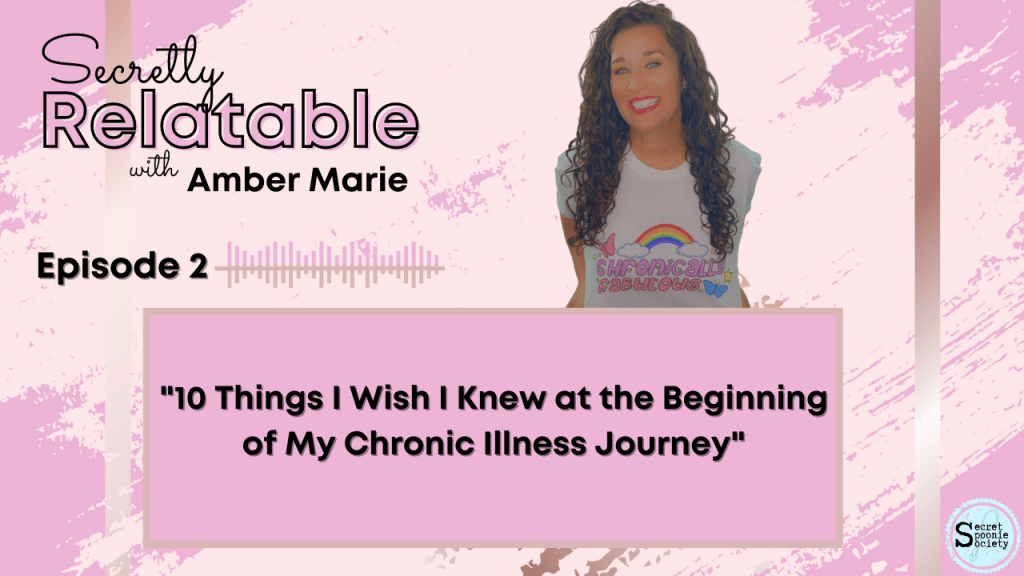
10 Things I Wish I Knew at the Beginning of My Chronic Illness Journey
- It’s NOT your fault. You shouldn’t feel guilty or ashamed of something that is not within your control. I really struggled with this in the beginning, and sometimes still do.
- Some people, including some medical professionals and even family and friends, may not believe you because you “don’t look sick” or because sometimes it may take a while to get an accurate diagnosis, so believe in yourself, keep good records, and keep going.
- Be an advocate for yourself. You are your best advocate, and if you find it hard to advocate for yourself, ask a trusted friend, relative, or partner to come to appointments with you to help on your behalf. They can take notes, offer another ear, and be a great comfort when you’re feeling overwhelmed or frightened at your appointments. You can also check your local resources as there are many different patient advocacy groups that may be able to offer an advocate if you don’t already have one.
- Find and/or build a good support system. There are online and in-person support groups, social media accounts and communities, mental health therapists and counselors, and even websites like TheMighty.com that have so many resources to offer for community support.
- Set boundaries. At some point, people you know, and even people that you don’t know, may offer you unsolicited health and medical advice. If it’s not coming for your medical team, please use discretion. Everyone knows someone who had what “you have” and they just did x, y, or z (fill in the blank) and then they were cured. And when you’re at the beginning of your journey, probably feeling your worst, you’re probably the most vulnerable too, and it can be hard to say no to people, especially when you’re desperate to feel better. Setting boundaries at the beginning over this issue would have saved me so much headache, heartache, and even money had I know I could just say “no thank you” and move on.
- Don’t play the comparison game. The comparison game crept up for me at the beginning of my journey when I would see someone who suffered from the same chronic illness as I did totally rocking their day or goals. I would think to myself, “What is wrong with me that I can’t get my act together?” not taking into account that while our illnesses may be the same, our experiences with them are not. This also goes for “Imposter Syndrome.” I would see someone with my same illness and think, “Wow, I don’t have it near as bad as they do, I should probably quit complaining, or feeling sad and get my act together.” How the brain draws these conclusions is beyond me, but they are definitely thoughts that crept in before I knew better. Here’s the thing. Everybody is different because every body is different. Two people can have the same illness and have completely different experiences with those illnesses. It doesn’t make one experience any more or less valid…just different.
- Learn and use ‘The Spoon Theory’ to explain to friends, family, and co-workers how energy currency works for someone who is chronically ill. I so wish this had been explained to me because goodness would it have saved me a lot of tears of feeling misunderstood. If you don’t know what ‘The Spoon Theory’ is, a quick Google search will explain it, but all I have to say is…”thank you Christine Miserandino for this beautiful and perfect metaphor.”
- Start tracking. Tracking my symptoms, food, mood, sleep, and other odds and ends would have helped give me so much more information and saved me a ton of time when I was being asked by doctors if I knew any of this information. When I started tracking, I was able to see correlations that I would have never seen, and then I was able to discuss them with my medical team. It was a total gamechanger and something I wish I would have done right from the start. Digital or analog, just start tracking.
- Realizing that “normal” is overrated because this is an emotional and mental rollercoaster, and going through the cycles of grief is part of the process. I went through shock, denial, anger, bargaining, depression, testing, and acceptance at the start of my journey, but if I’m being honest, I still go through waves of grief almost 11 years after my first diagnosis. I grieve the life I would have had, the person I thought I would be, and some of the dreams that I had to let go of because they asked too much of my body. I would have gotten into counseling first thing, so someone could have helped me navigate and process everything that I was feeling both inside and out. There is just as much a mental and emotional component to chronic illness as there is a physical one, and finding a professional to help give you healthy tools to deal with all of it would have changed my life for the better a lot sooner.
- It’s okay to ask for help. It’s also okay if the best you can do right now is exactly what you’re doing right now. Dirty dishes in the sink, laundry piles everywhere, same pair of pajamas for 3 days in a row, take-out for dinner-no judging yourself. At the start of this, I was still trying to do everything my “healthy” self would, and that proved futile. Looking back, I would have given myself a lot more grace for doing my best, and then I would have accepted help when people offered it. You’re not weak for asking for help. You’re human. We can’t do it all, especially when our bodies are on the fritz. Asking for and receiving help is still one of the best ways that I practice self-care to this day. It’s not always easy, but I wish that I hadn’t been so stubborn and strong-willed in the very beginning. I wasted so much energy that I didn’t have to spare trying to prove that I was superhuman.
This list gets added to the further along I move in my health journey because I continue to learn more about myself, my body, and my abilities. These are just a few of the the things that I wish that I had known from the start, when I was struggling the most with my new diagnosis and all that came with it.
If you are someone newly diagnosed, or even someone smack dab in the middle of your chronic illness journey, please know that you aren’t alone. I know it can be really overwhelming. It can be a huge adjustment, and you’ll find you’re always adjusting to some degree. Just take it one day at a time and keep having grace for yourself knowing your doing your best, and that that’s enough.

 Amber Marie