Episodes, podcast

Secretly Relatable Podcast: ‘The Chronic Chronicles’ Season 1, Episode 3

Click the link to listen to today’s episode!
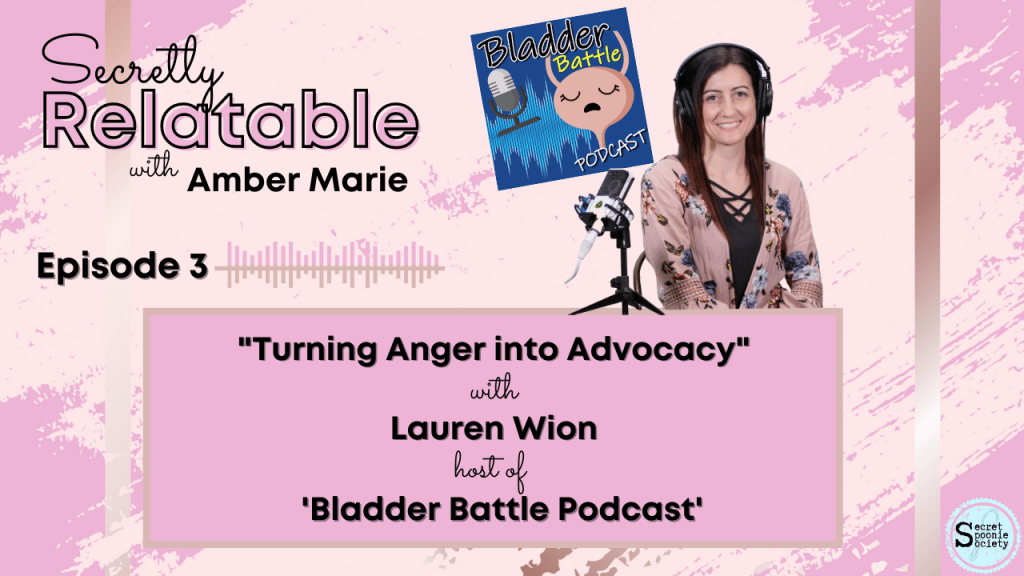
In today’s episode, I had the privilege of interviewing fellow chronic illness warrior and host of one of my favorite chronic illness podcasts, Lauren Wion. Lauren started her podcast after struggling with anger, denial and feelings of being alone on her health journey and set out to not only create awareness around Epstein Barr Virus and Interstitial Cystitis, but also to create a platform that provides a plethora of information and resources to those who may be feeling all alone on their own health journey. She’s passionate about creating a sense of community and shedding light around all the aspects of health issues that are often left in the dark.

Here are few things that I asked Lauren to share about her struggle with chronic illness:

What are 3 things that you wished that you knew while you were really struggling at the beginning of your chronic illness journey?

Lauren: “What remedies work- supplements, herbs, etc., how many different types of symptoms everyone feels, and that seeing a urologist may not always be the best course of action.”

How important has it been to find purpose through your struggle/chronic illness/invisible illness?

Lauren: “So important! I was in the denial stage for a while, until I started doing my podcast and started hearing “my story” in other people stories. Once I accepted and identified, I became relieved and more at ease.”

What motivated you to start your podcast Bladder Battle?

Lauren: “I was angry, and the horrific medical care experience I had been put through for 4 years. I wanted to help others to avoid going through the same thing.”

Why is it important to you to help shed light on Interstitial Cystitis?

Lauren: “It’s so confusing and can be misleading for many years for most [people].”

Are there any fears that you ‘ve had to overcome on your journey so far?

Lauren: “In general my anxiety increased, and I started to be afraid to go and do things. I also didn’t have the best outlook on my life and had to find a way to pull myself up by introducing monumental moments back into my life as things to look forward to- i.e. going back to school, going to reformer pilates, and perfecting my alignment.”

Are there any people who inspire you?

Lauren: “I am inspired by the community of IC warriors and professionals that I have met through my podcast. I am also inspired by many functional and naturopathic doctors out there that are providing alternative approaches to healing and understanding chronic/autoimmune illness.”

Best piece of advice that you’ve been given from a fellow warrior, and any tips, tools, or tricks that have helped you along the way?

Lauren: “Don’t compare your current situation to your old life. And lots of great people out there-Dr. Kasey Holland, Dr. Becky Campbell, Dr. Jeffrey Bland, Dr. Will Cole-and of course some of the doctors that I have had on my podcast!”

If you want to connect with Lauren and check out her amazing podcast, she can be found down below:
Youtube

Bladder Battle Podcast

Instagram

Episodes, podcast

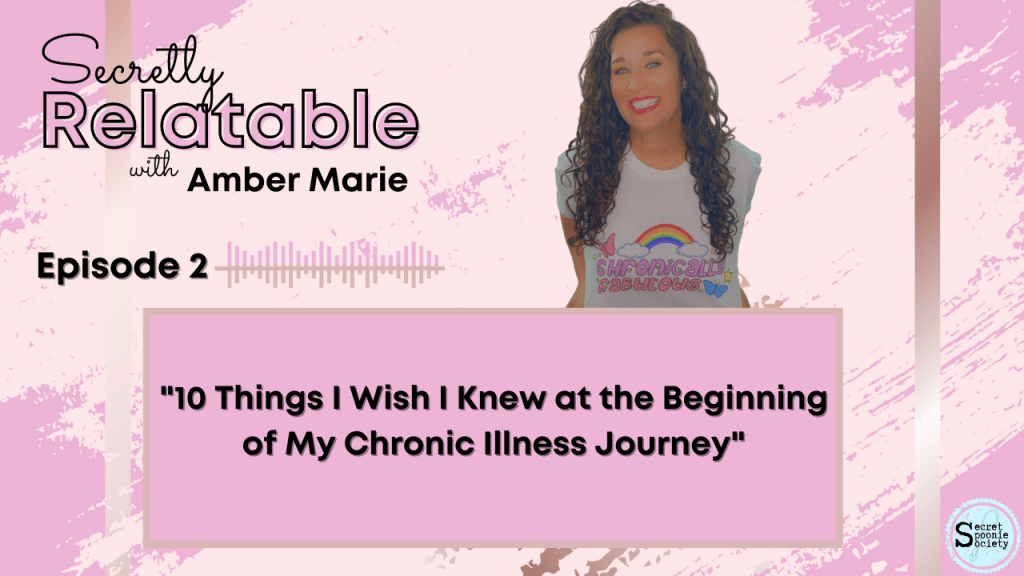
Secretly Relatable Podcast: ‘The Chronic Chronicles’ Season 1, Episode 2

Listen to today’s episode here

10 Things I Wish I Knew at the Beginning of My Chronic Illness Journey

  1. It’s NOT your fault. You shouldn’t feel guilty or ashamed of something that is not within your control. I really struggled with this in the beginning, and sometimes still do. 
  2. Some people, including some medical professionals and even family and friends, may not believe you because you “don’t look sick” or because sometimes it may take a while to get an accurate diagnosis, so believe in yourself, keep good records, and keep going.
  3. Be an advocate for yourself. You are your best advocate, and if you find it hard to advocate for yourself, ask a trusted friend, relative, or partner to come to appointments with you to help on your behalf. They can take notes, offer another ear, and be a great comfort when you’re feeling overwhelmed or frightened at your appointments. You can also check your local resources as there are many different patient advocacy groups that may be able to offer an advocate if you don’t already have one. 
  4. Find and/or build a good support system. There are online and in-person support groups, social media accounts and communities, mental health therapists and counselors, and even websites like TheMighty.com that have so many resources to offer for community support. 
  5. Set boundaries. At some point, people you know, and even people that you don’t know, may offer you unsolicited health and medical advice. If it’s not coming for your medical team, please use discretion. Everyone knows someone who had what “you have” and they just did x, y, or z (fill in the blank) and then they were cured. And when you’re at the beginning of your journey, probably feeling your worst, you’re probably the most vulnerable too, and it can be hard to say no to people, especially when you’re desperate to feel better. Setting boundaries at the beginning over this issue would have saved me so much headache, heartache, and even money had I know I could just say “no thank you” and move on. 
  6. Don’t play the comparison game. The comparison game crept up for me at the beginning of my journey when I would see someone who suffered from the same chronic illness as I did totally rocking their day or goals. I would think to myself, “What is wrong with me that I can’t get my act together?” not taking into account that while our illnesses may be the same, our experiences with them are not. This also goes for “Imposter Syndrome.” I would see someone with my same illness and think, “Wow, I don’t have it near as bad as they do, I should probably quit complaining, or feeling sad and get my act together.” How the brain draws these conclusions is beyond me, but they are definitely thoughts that crept in before I knew better. Here’s the thing. Everybody is different because every body is different. Two people can have the same illness and have completely different experiences with those illnesses. It doesn’t make one experience any more or less valid…just different. 
  7. Learn and use ‘The Spoon Theory’ to explain to friends, family, and co-workers how energy currency works for someone who is chronically ill. I so wish this had been explained to me because goodness would it have saved me a lot of tears of feeling misunderstood. If you don’t know what ‘The Spoon Theory’ is, a quick Google search will explain it, but all I have to say is…”thank you Christine Miserandino for this beautiful and perfect metaphor.”
  8. Start tracking. Tracking my symptoms, food, mood, sleep, and other odds and ends would have helped give me so much more information and saved me a ton of time when I was being asked by doctors if I knew any of this information. When I started tracking, I was able to see correlations that I would have never seen, and then I was able to discuss them with my medical team. It was a total gamechanger and something I wish I would have done right from the start. Digital or analog, just start tracking. 
  9. Realizing that “normal” is overrated because this is an emotional and mental rollercoaster, and going through the cycles of grief is part of the process. I went through shock, denial, anger, bargaining, depression, testing, and acceptance at the start of my journey, but if I’m being honest, I still go through waves of grief almost 11 years after my first diagnosis. I grieve the life I would have had, the person I thought I would be, and some of the dreams that I had to let go of because they asked too much of my body. I would have gotten into counseling first thing, so someone could have helped me navigate and process everything that I was feeling both inside and out. There is just as much a mental and emotional component to chronic illness as there is a physical one, and finding a professional to help give you healthy tools to deal with all of it would have changed my life for the better a lot sooner. 
  10. It’s okay to ask for help. It’s also okay if the best you can do right now is exactly what you’re doing right now. Dirty dishes in the sink, laundry piles everywhere, same pair of pajamas for 3 days in a row, take-out for dinner-no judging yourself. At the start of this, I was still trying to do everything my “healthy” self would, and that proved futile. Looking back, I would have given myself a lot more grace for doing my best, and then I would have accepted help when people offered it. You’re not weak for asking for help. You’re human. We can’t do it all, especially when our bodies are on the fritz. Asking for and receiving help is still one of the best ways that I practice self-care to this day. It’s not always easy, but I wish that I hadn’t been so stubborn and strong-willed in the very beginning. I wasted so much energy that I didn’t have to spare trying to prove that I was superhuman.  

This list gets added to the further along I move in my health journey because I continue to learn more about myself, my body, and my abilities. These are just a few of the the things that I wish that I had known from the start, when I was struggling the most with my new diagnosis and all that came with it.

If you are someone newly diagnosed, or even someone smack dab in the middle of your chronic illness journey, please know that you aren’t alone. I know it can be really overwhelming. It can be a huge adjustment, and you’ll find you’re always adjusting to some degree. Just take it one day at a time and keep having grace for yourself knowing your doing your best, and that that’s enough. 

Episodes, podcast

Secretly Relatable Podcast: ‘The Chronic Chronicles’ Series

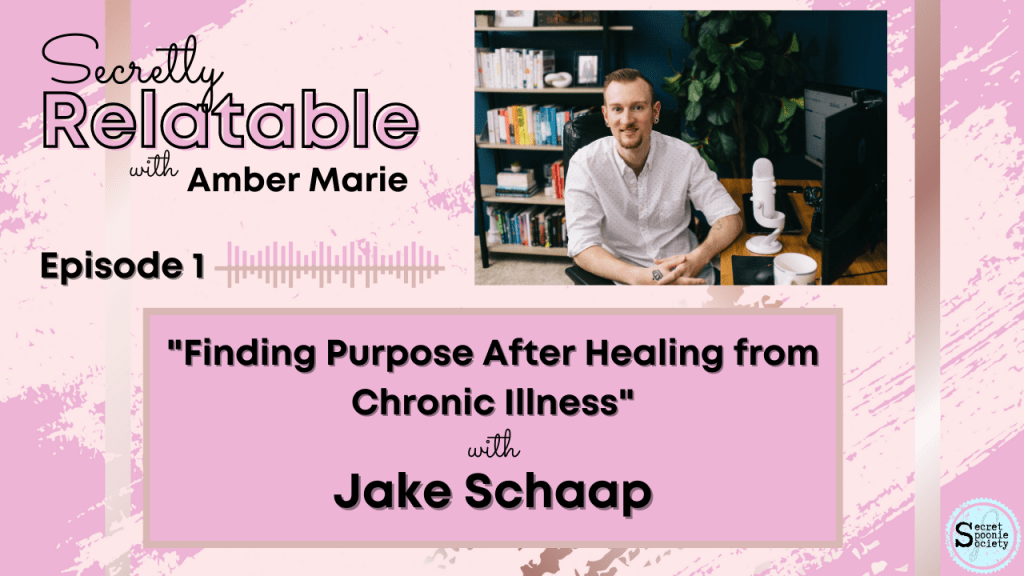
Season 1, Episode 1: “Finding Purpose After Healing from Chronic Illness” with Jake Schaap

Listen to this episode here: link

When You’re Whole World Gets Turned Upside Down

Jake was in the prime of his life, just finishing college, about to marry the love of his life, when he was hit with a life-altering diagnosis: Inflammatory Bowel Disease, more specifically, ulcerative colitis. Thankfully, Jake’s disease was caught relatively early, and he was able to get intervention and treatment quickly. After spending the next several years battling some pretty difficult symptoms, and a variety of treatments, Jake made the difficult decision to have a colectomy, a surgical procedure that removes part or all of the colon. What was supposed to be a smooth 5 month process, ending up turning into a two year battle, full of several complications that landed him in the ICU and almost cost him his life.

Now 32 years old, Jake has been in remission for about 4 years, off his medication, and is in the best shape of his life. He is on a mission to share his story and bring awareness to this disease, and those affected by chronic illness. One of Jake’s passions as an advocate and full-time web-developer, is to help autoimmune and chronic illness warriors be able to create online businesses that work with an individuals own health limitations and terms, while being able to provide for themselves and/or their family.

“My autoimmune journey changed my life for the better. And I am thankful that I was able to go through that, and that’s why I want to help people.”

I asked Jake at the end of our interview, who inspires him most, and as someone with such a positive mindset, his answers did not disappoint.

He stated:

  • People in this community who continue to share their light, and who continue to move forward to the best of their ability.
  • His beautiful and amazingly supportive wife and partner.
  • Strong support systems, or teams that advocate for those when they need it most.

Lastly, Jake mentioned a tool that he swears by in helping him create and maintain his routines, set goals, and cut back on decision fatigue. It’s the Full Focus Planner, by Michael Hyatt, and you can check it out for yourself at: www.fullfocusplanner.com

If you would like to connect with Jake (and you totally should), here is where you can find him!

Website: jakeschaap.com

Instagram: @jakeschaap 

YouTube: https://www.youtube.com/JakeSchaap1106

podcast

Podcast Trailer Release!

Click here to listen to the trailer!

It’s finally here and I am so excited for this new year and new adventure! Initially scheduled to release in December, in true 2020 fashion, curveballs were thrown, and a I had to push back the release to this year, but I am so glad that this is the first big announcement that I get to make for 2021!

A little about the new podcast…

I don’t know about you, but there have been times in my life when I’ve felt like I am the only one struggling with certain things, and it’s a pretty isolating feeling. But, if I’ve learned anything through my years as a health coach and advocate, it’s that no one is immune to struggling and how much of a vital role community support plays in not only helping us through our struggles but also in our ability to connect with those in that community when our personal battles try to isolate us. There is something that just hits differently when you feel like you can relate to someone over an experience, or that almost magical moment when you say, “Oh, hey! You too? I thought it was just me!” It’s like suddenly you feel seen and validated for the first time, and not like the isolated outsider or imposter that you were feeling prior to that. A weight gets lifted at that moment, and you can finally breathe. 2020 taught us a lot, but I think for the first time as a collective whole, we learned how important connection is to our overall well-being. There are so many secret and maybe not-so-secret struggles, and I can’t help but feel that the more that we create a safe space to talk about these things, the more we can begin to heal as a whole and the better we can show up in our own lives and for the people who matter to us most.

The chronic illness community has taught me a lot. More than I could ever put into words here, but after finding my community and connecting with so many incredible people these last few years, and seeing the profound shift in my own health journey, it got me thinking that there have to be others out there who feel the same way I do. People who just need to feel seen, and have their experiences validated to know that they aren’t alone in the world. So that’s where “Secretly Relatable” comes in. This new show will be all about creating a safe space for everyday people to share their stories and struggles, and how they’ve managed to figure out a way over, under, around, and through them. My guests and I will be sharing our tools, tips, and resources that have helped us along the way. Our struggles may not always look the same, but it doesn’t mean we can’t relate to the feeling of struggling, and benefit from adding tools to our toolbox when we find ourselves in a struggle season again, because p.s., no one gets through this life without struggling with something, sometime-no matter what it looks like from the outside.

Episodes will be released every Wednesday, and I would love for you join me on this new adventure.

P.S. If you’re interested in hearing about a certain topic, or are interested in being on the show, please feel free to connect with me on social media, or send me an email at: theautoimmuneadvocate@gmail.com

Uncategorized

When You’re Searching for Answers to Your Health

Maybe you haven’t been feeling very well lately. Maybe you’ve felt a little off. Maybe there have been some new symptoms or some that just seem to keep nagging at you no matter what you try to do on your own. Maybe there have been some scary incidences. Maybe some of them landed you in the emergency room or urgent care out of fear and desperation.

Maybe…that’s a whole lot of maybes.

We know our bodies. We know what our “normal” feels like because we’ve lived in our bodies our entire lives. When something isn’t right, and we run through all of the tools in our toolbox, we seek professional help. But what happens when you’ve been released from the emergency room with a pat on the head and discharge papers that read, “panic/anxiety attack?” What happens after you follow up with your primary and all the “routine” tests come back normal, and you’re dismissed without help with your symptoms yet again? What then?

There my friend, and fellow warrior, there is where you take your fear, and your anger, and your pain, and you learn how to become your own advocate.

Most of us know how to advocate for others. We intervene on behalf of friends, family, co-workers, and neighbors when we see an injustice unfolding. That feeling of helplessness ignites something primal and we get to work to right the wrong. But what about ourselves? Are we as quick to rally on our own behalf? Especially when we are going up against the experts, who are supposed to have the answers?

That’s when it can feel the most overwhelming for so many. It’s the fight-flight-or freeze moment, and many of us freeze. We are already exhausted from not feeling well, and all that goes along with that, and then the people who are supposed to know, who are supposed to help us when we are at our most vulnerable, can’t. Or worse…dismiss us.

So what are we to do?

We still have a problem that needs answering.

Self-advocating is just supporting yourself in your time of need, and listening to that inner intuition that says, “something isn’t right.” It’s setting you up for the best possible chance to get the answers you’re seeking. It’s about fighting for your health and well-being, and in some cases, maybe even your life. You are worth the fight. But it helps to know how to advocate for yourself.

Here are a few tips that I wish I would have known when I first started my journey in search of answers:

  1. Keep a symptom log/ journal.
    • By keeping track of your symptoms, you can give your doctor quick and valuable access to information like duration, severity, diet-related, after an activity, etc. When you’re not feeling well, recall can be difficult, and this one little tool can be the difference between connecting the dots shortly, or it taking much longer.
  2. Keep a records folder.
    • This is self-explanatory but often taken for granted early in the chronic illness journey. It can take a while to get in with specialists, and we all know our time with them is limited and hurried when they are in the room with us. Having your records on hand for quick review saves time, money, and the headache of lost record requests.
    • By law (HIPAA) you are entitled to see and get copies of your medical records. There are a few exceptions, and you might be charged for them. But you absolutely have a right to ask, so make sure to check your local state statutes and laws for clarification.
  3. Learn about your family history, if you are able.
    • The more information you can bring to your appointment, the better. Did grandma have a chronic illness? Is there a history of a relative maybe no one ever talked about? Now is the time to learn if you have access to it.
  4. Get multiple opinions.
    • This is not a sprint, this is a marathon. And by that, I mean finding the right diagnosis for many can take years. I don’t say that to discourage you, I say it to help you strengthen your resolve. Remember you’re fighting for yourself, so don’t get discouraged. Physicians are human, they don’t always get it right. There are great practitioners out there, sometimes it just takes a little more time to find them or the correct diagnosis.
  5. Find a support system.
    • This journey you’re on isn’t always easy, and it’s nice to have people in place who can empathize, understand, and hold space for you. There will be good days, and bad days, and all kinds of in-between days. Having a strong support system in place helps more than I can say.
    • Social Media is a great place to start. Facebook has a community group feature which is nice because of the privacy settings. Sometimes you want to be able to share, but also know that it stays inside the circle. Facebook fulfills that when you can’t find an in-person support group. Personally, Instagram helped me so much because of its searchable hashtag feature. I was able to find the #chronicillness community and for that, I will be forever grateful.
    • My DM’s and email are always open. Please don’t hesitate to reach out and connect.
Photo credit: @theinvisiblediaries